

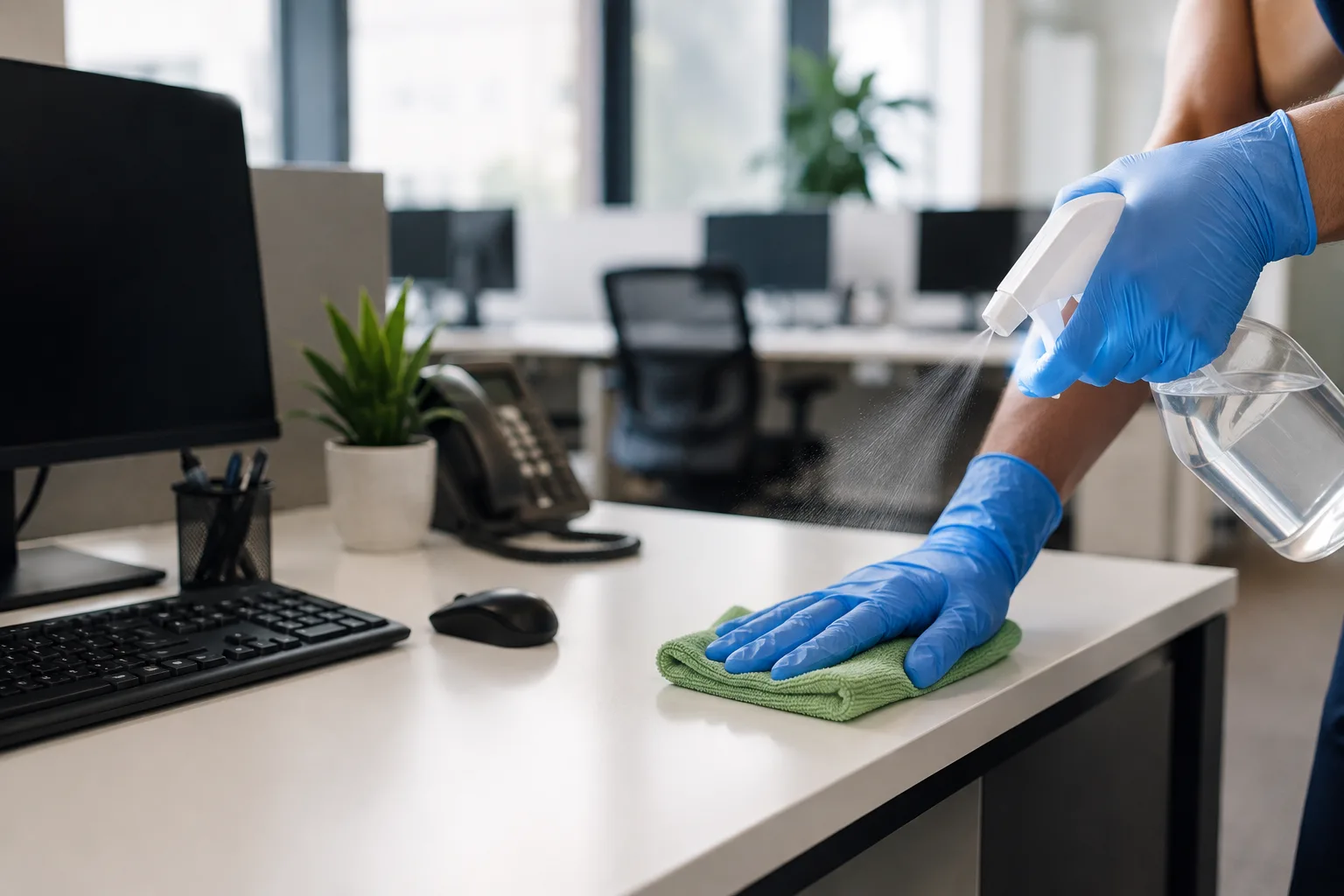
Every October the same thing happens. Two people call in sick, a third is coughing at their desk, and the response is to clean everything harder — more wipe-downs, more spray, more visible effort. Flu season office cleaning feels productive, but effort and effectiveness are not the same thing, and pointing both at the wrong surfaces protects no one.
Here is the uncomfortable starting point, straight from public-health guidance: flu spreads mainly through the air and close contact, not through the surfaces you can see. That doesn't make cleaning pointless. It means cleaning has a specific, limited job, and the workplaces that stay healthiest are the ones that do that job well while spending the rest of their attention elsewhere.
This article separates three things: the cleaning that genuinely reduces flu transmission, the cleaning that offers limited extra benefit, and the non-cleaning measures that do the heavy lifting. The goal is risk reduction and smarter spending — not a flu-free office, which no cleaning program can promise.
How Does Flu Spread in an Office?
Influenza spreads primarily through respiratory particles released when an infected person coughs, sneezes, talks, or breathes, and through close contact in shared indoor spaces. A secondary route exists: someone with the virus on their hands touches a surface, another person touches it, then touches their eyes, nose, or mouth. That route is real but lesser.
Picture one sick employee arriving Monday. They cough near a colleague in a meeting, share air in a conference room for an hour, press the elevator button, and refill coffee in the kitchen. The two exposures most likely to spread flu happened in the air of the meeting and the close contact — not on the elevator button, though the button is the part your cleaning can actually touch.
What matters most for where you focus:
- Respiratory particles and close contact drive most transmission and are addressed by ventilation, distance, and sick people staying home
- High-touch shared surfaces are the meaningful cleaning target — objects many hands contact between cleanings
- Low-touch surfaces in shared office spaces carry little transmission risk, however visibly clean they look
An empty, spotless desk is not your biggest risk in an occupied office. The occupied part is.
Which Office Cleaning Practices Help Reduce Flu Transmission?
Target frequently touched shared surfaces, clean before you disinfect, and match effort to how heavily a space is used. That is the whole of what surface cleaning contributes to workplace flu prevention, and done consistently it is worth doing.
First, the distinction that governs everything else. Cleaning uses soap or detergent to physically remove germs and dirt from a surface. Sanitizing reduces remaining germs to a safer level. Disinfecting uses an EPA-registered product to kill germs left after cleaning. CDC is explicit that you clean first — dirt makes disinfectants work less well — and that in most situations, regular cleaning is enough to prevent the spread of germs.
When is disinfecting worth it? CDC's answer for community facilities: in addition to cleaning, disinfect where someone has obviously been ill, and consider it for high-traffic areas. That is a targeting instruction, not a blanket one.
High-priority surfaces for office cleaning to prevent flu:
- Entries and circulation: door handles, push plates, elevator buttons, stair rails, light switches
- Shared kitchen: refrigerator and microwave handles, faucet, coffee equipment, shared surfaces
- Restrooms: faucets, flush handles, stall latches, dispensers
- Conference rooms: table surfaces, shared remotes, phone consoles, whiteboard markers
- Shared equipment: printer and copier touchpads, shared keyboards, point-of-sale screens
The prioritization rule for a facility manager is simple: rank by hands-per-day, not by square footage. A single elevator button touched by 200 people outranks an acre of unused carpet. And whatever the surface, follow the product label — including the contact time the surface must stay wet for a disinfectant to work. Pair all of it with easy hand hygiene, because cleaning high-touch office surfaces and clean hands are two halves of the same defense.
What Office Cleaning Practices Don't Do Much to Prevent Flu?
The low-value practices are the ones that treat surface cleaning as if it addressed airborne spread. None of these are harmful; they are just misallocated effort that buys a feeling of safety rather than a reduction in risk.
| Common belief | Reality |
|---|---|
| "Disinfect every surface, constantly" | Low-touch surfaces carry little risk; constant disinfection there adds little while raising chemical exposure and cost |
| "A visibly clean surface is a safe surface" | Clean appearance says nothing about airborne risk, which is where most flu spreads |
| "More cleaning frequency is always better" | Frequency without targeting or correct technique wastes labor; a well-cleaned high-touch surface beats a fast wipe of everything |
| "Strong-smelling products clean better" | Odor is not efficacy; contact time and correct use determine results |
| "Surface cleaning can stop an office outbreak" | It cannot reach person-to-person or airborne transmission, which need ventilation and sick-day behavior |
One point deserves care because it is easy to oversell. Whole-room fogging and electrostatic spraying have a place — applying disinfectant efficiently across genuinely high-touch areas or after a known contamination event. But CDC does not recommend fogging or electrostatic spraying as a primary method of routine surface disinfection unless the product label specifically allows it. Translated for an office: these tools are a targeted response, not a weekly ritual for an empty open-plan floor.
"Limited benefit" is not "useless." Cleaning low-touch surfaces keeps the office pleasant and removes ordinary grime. It just should not be where your flu-prevention budget concentrates.
Why Office Cleaning Isn't Enough for Flu Prevention
Cleaning is one layer in a stack, and the layers that address respiratory spread matter more. No single measure is sufficient, which is exactly why they work — several modest interventions stacked together reduce risk more than any one pushed to excess.
Map each intervention to the route it actually addresses, and the priorities reorder themselves:
| Measure | Route it addresses | Relative role |
|---|---|---|
| Sick employees stay home | Removes the source entirely | Highest impact |
| Ventilation / fresh air | Airborne particles | High |
| Hand hygiene | Hands-to-face and surface route | High |
| High-touch surface cleaning | Surface route | Moderate, and your vendor's core job |
| Reducing close contact when symptomatic | Close-contact spread | Situational |
| Seasonal vaccination | Individual susceptibility | Per public-health guidance |
The practical read for an employer: a sick-leave policy that doesn't punish people for using it will prevent more office flu than any cleaning upgrade. Accessible hand sanitizer and better airflow come next. Then targeted surface cleaning does its part. Vaccination is an individual medical decision, and the right source for that is your own clinician and public-health guidance — not a cleaning company.
How to Build an Effective Flu-Season Office Cleaning Plan
A good plan is a targeting document: what gets cleaned, how often, and when disinfection is triggered. Use a simple daily / periodic / as-needed structure and write it down so nobody improvises at 8 p.m.
Flu-season cleaning plan:
- Map high-touch surfaces in reception, conference rooms, kitchens, restrooms, break rooms, and shared equipment
- Set daily cleaning of those surfaces with soap or detergent, cleaning before any disinfection
- Define disinfection triggers: a known illness, visible contamination, or a high-traffic area — not a fixed everything-every-day rule
- Require label compliance: correct product for the surface, full contact time, no mixed chemicals
- Escalate around a sick person: add attention to areas they used, then return to baseline
- Stock hand hygiene — soap in every restroom, sanitizer at entries and shared points
- Tie cleaning to your illness policy so the crew's escalation and your sick-leave rules point the same way
For execution, brief the crew on a few non-negotiables and keep them consistent: train on cleaning-versus-disinfecting technique, use the right product for each surface, never mix chemicals, and log high-touch cleaning where a record is useful. Review the plan against how the office is actually used as the season progresses. Consistency and correct technique beat volume every time. Our office cleaning scope guide and the factors behind cleaning pricing cover how this maps to a real contract.
Takeaway: if your flu-season plan says only "clean more," it isn't a plan. Name the surfaces, the frequency, and the disinfection trigger — that's the whole document.
The Smart Approach to Flu Season Office Cleaning
Flu spreads mostly through the air and close contact, with contaminated hands and surfaces a real but secondary route. Targeted cleaning of high-touch shared surfaces, plus disinfection when someone has been ill or in high-traffic zones, does genuine work. Cleaning every surface constantly does not — it buys reassurance, not protection.
The healthiest workplaces run flu season office cleaning as one layer inside a stack: sick employees stay home, hands stay clean, air keeps moving, and the cleaning crew focuses where hands actually land. Match the effort to the risk, and you protect people while spending your cleaning budget where it earns its keep.
This is a good week to pull your current flu-season protocol and check one thing: does it name specific high-touch surfaces and a disinfection trigger, or does it just say "increase cleaning"? If it's the second, it's due for a rewrite. Offices in New York, New Jersey, and Pennsylvania can request an estimate for a targeted plan, or read more about our office disinfection services and where they fit.
Sources & notes
- When and How to Clean and Disinfect a Facility (community settings including offices), reviewed April 16, 2024 — CDC, Water, Sanitation, and Environmentally Related Hygiene (WASH)
- Cleaning and Disinfecting — definitions and when disinfection is warranted — CDC WASH
- This article is general workplace guidance, not medical advice. For vaccination and personal health decisions, consult a clinician and current public-health guidance.

Written by
Hazel Glory BorreDirector of Support, ProCleanings
Hazel leads operational support at ProCleanings — coordinating scheduling, client communication, and quality assurance so service delivery stays consistent and accountable.