

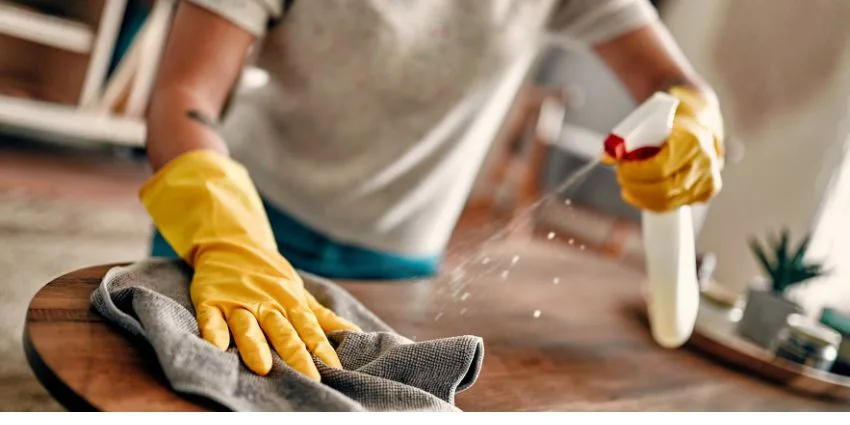
A resident emails at 7:40 a.m. about a spill on the third floor. A prospect tours at 11. Your porter called out. Apartment building cleaning services exist so that chain of events never becomes your morning — and when they work, most residents never think about them at all.
Cleanliness is the first thing anyone judges your property on. A prospect forms an opinion in the lobby, before they see a unit. A resident forms one every time they walk to their door. Neither is evaluating your rent roll — they are looking at the floor.
Apartment buildings also demand a different approach than houses do. You are cleaning shared, occupied, high-traffic space on a schedule — not a private home on a visit. When that schedule slips, failures compound into complaints, bad reviews, and deferred issues that become repairs.
This guide covers what to buy, how to price it, how to vet a vendor, and how to hold one accountable.
What Do Apartment Building Cleaning Services Include?
Professional cleaning for apartment buildings covers the shared spaces the owner controls — lobbies, corridors, stairwells, elevators, laundry and amenity rooms, and refuse areas — on a recurring schedule, plus vacant-unit turns and periodic deep work a daily crew doesn't touch. Vendors sell the same work under different names: apartment complex cleaning services, residential property cleaning services, multifamily building janitorial services. Compare scopes, not labels — there is no standard package.
A typical scope of work includes:
- Common area cleaning: lobby and hallway cleaning, stairwells, elevator cabs and tracks, mail and package rooms
- Floor care: vacuuming, mopping, spot treatment, entry mats, periodic stripping and waxing
- High-touch sanitation and disinfection: door handles, push plates, elevator buttons, handrails, intercoms
- Restroom and amenity cleaning where you have a leasing office, gym, or clubhouse
- Trash and refuse areas: chute and compactor rooms, bin washing, set-out and retrieval
- Move-in and move-out cleaning for vacant units
- Periodic services: carpet care, window cleaning, pressure washing, garage sweeping
Scope should track your building. A 24-unit walk-up may need three visits a week and stairwells that get mopped, not swept. A 300-unit garden community needs a day porter and a pet-waste route. A doorman high-rise needs glass and brass touched hourly — that is a staffing model, not a task list. Apartment cleaning services for property managers should be quoted against your floor plan and traffic.
Which apartment cleaning tasks are legally required?
Some of this is not discretionary. In New York City, the Housing Maintenance Code requires owners to keep the public parts of a dwelling clean and sanitary (NYC Admin. Code § 27-2011) and to provide adequate janitorial services, with specific staffing obligations in multiple dwellings of nine or more units (§ 27-2053). Local Law 55 of 2018 goes further: owners of buildings with three or more apartments must inspect units and common areas annually for mold and pests, use integrated pest management, and remediate visible mold and infestation before a new tenant reoccupies a unit (HPD guidance).
In NYC, turnover cleaning is a compliance step, not a courtesy. Requirements vary by jurisdiction — verify your local housing code, then write it into your vendor's scope.
How Professional Cleaning Impacts Tenant Satisfaction and Property Value
Treat cleaning as an operating system, not a line item. It is one of the few building services every resident touches daily, and one a prospect can evaluate in thirty seconds without asking you a question.
Consider two identical 90-unit buildings. In the first, a porter walks the property every morning: trash room hosed, glass wiped, landings clear. In the second, a crew comes twice a week and the compactor room smells by Thursday. Same rents, same finishes — and the second building generates the complaints, the bad reviews, and the prospects who tour politely and lease elsewhere.
Why it matters
- Leasing: your lobby sets the frame for the entire tour
- Retention: renewals are decided by accumulated daily impressions, not your renewal letter
- Complaint volume: consistent cleaning removes a whole category of work order from your queue
- Early detection: a porter in the stairwell every day is your cheapest inspection
That last one is underrated. Professional apartment building cleaning puts a trained person in every shared space on a fixed rhythm. They see the ceiling stain, the roach activity by the chute, the loose handrail, the door that stopped latching — weeks before a resident reports it. Require written reporting and a cleaning contract becomes a preventive apartment building cleaning and maintenance input.
How Property Managers Can Choose the Right Apartment Cleaning Company
Evaluate multifamily property cleaning services against ten criteria, in this order:
- Multifamily experience. House cleaning and office janitorial are different disciplines. Ask how many residential buildings they service now, at what size, and whether they work occupied common areas during resident hours.
- Defined scope. Get a written task list mapped to specific areas. "Clean common areas" is not a scope of work.
- Customization. Can they run five days at one property and seven at another, and shift hours seasonally?
- Staffing model. Ask headcount per shift, who supervises, and how call-outs are covered. Backup coverage is where most contracts fail.
- Quality control. Ask to see their inspection form and what happens when a checkpoint fails. Look for photo-verified checklists and a documented corrective-action loop. For an external signal, ISSA's Cleaning Industry Management Standard (CIMS) is assessed by an independent third party and applies to the whole organization, not one crew; certified firms are listed in a public directory you can check yourself.
- Insurance and compliance. Verify general liability and workers' compensation, and get a certificate naming you as additional insured.
- Communication. One named account manager, a stated response window, and a channel your site team will use.
- Pricing transparency. Require every bid to state weekly labor hours and headcount, not just a monthly number.
- References. Ask for two properties of similar door count — and call them.
- Trial period. Start with 60 to 90 days against written measures: inspection scores, response times, call-outs.
Why the cheapest bid usually isn't the cheapest. Divide each monthly price by the labor hours committed. That effective hourly rate makes bids comparable for the first time. A bid 30% below the field is almost never 30% more efficient — it is fewer hours, thinner supervision, or wages that guarantee turnover. You pay the difference in re-cleans and a re-bid in nine months. Apply the same scrutiny to the service contract and the pricing factors behind it.
Questions to Ask Before Hiring
- How many labor hours per week are in this price, and how many people?
- Who supervises on site, and how often are they physically here?
- What happens when someone calls out?
- Show me last month's completed inspections for a comparable property.
- Are your cleaners employees or subcontractors?
- What is included in a move-out clean, item by item?
- What is your response time at 4 p.m. on a Friday?
How Often Should an Apartment Building Be Professionally Cleaned?
High-traffic shared spaces need daily attention; everything else runs weekly, monthly, or quarterly. Build the schedule from actual traffic, not a template.
| Frequency | Typical tasks |
|---|---|
| Daily | Lobby, entry glass, elevator cabs, high-touch surfaces, trash and compactor rooms, main corridors |
| Weekly | Stairwells, laundry and amenity rooms, mail and package rooms, secondary corridors, hard-floor mopping |
| Monthly | Baseboards, light fixtures, vents, corridor spot-carpet work, garage or exterior sweep |
| Quarterly | Carpet extraction, floor refinishing, window cleaning, pressure washing |
Adjust for reality. Pet-friendly properties need more corridor carpet work. Winter salt turns entryways into a daily floor-care problem. Summer means more amenity use and more trash. Review apartment community cleaning schedules twice a year — before peak leasing and before winter — and change frequencies rather than piling on one-off requests.
Best Practices for Managing Apartment Building Cleaning Services
Signing the contract is the easy part. Consistency comes from management:
- Put standards in writing. A property-specific checklist by area, with frequencies, beats a generic scope.
- Assign ownership. Name the person on your team who signs off and the person on theirs who answers.
- Inspect on a schedule. Walk the property with the account manager monthly, with photos and dated notes.
- Route resident complaints through one channel so the vendor sees the same record you do.
- Review quarterly against inspection scores, response times, and complaint counts.
- Fix root causes. A recurring odor is a broken chute gasket or a bin-washing gap, not a mopping failure.
Takeaway: if you can't produce three months of dated inspection records today, that's the first gap to close.
Choosing the Right Cleaning Strategy for Your Apartment Property
Apartment buildings need structured, property-specific plans, not a residential package scaled up. Good multifamily property cleaning services protect appearance, cut complaint volume, surface maintenance issues early, and in many jurisdictions keep you on the right side of housing code. Choose on staffing depth, quality control, communication, and insurance — and normalize every bid to a price per labor hour before comparing.
Before your next leasing push: walk the property with your checklist, mark every area not meeting standard, and count how many are scope gaps versus performance gaps. That list is your RFP. See what a full apartment building cleaning and maintenance program covers, then request an estimate and compare it to what you pay now — per hour, not per month.
Sources
- New York City Administrative Code § 27-2011, Cleaning of interior shared space — American Legal Publishing code library
- New York City Housing Maintenance Code, Article 13 (Janitorial Services), § 27-2053 — nyc.gov (PDF)
- Indoor Allergen Hazards: Requirements for Multiple Dwellings, Local Law 55 of 2018 — NYC HPD Office of Enforcement and Neighborhood Services (PDF)
- Cleaning Industry Management Standard, certification overview and certified-organization directory — ISSA